Certification
How to Get Certified in Russian Manicure Online
There’s no single “Russian manicure license” — so what does certification actually mean, and how do you pick a program worth the hours?
You get certified in Russian manicure by completing a structured training program that covers the theory, the e-file technique and a certification exam, then receiving a certificate you can prove is real. There’s no single government-issued “Russian manicure license” — certification comes from the course provider, and online, self-paced programs let you certify from anywhere with lifetime access to the material.
“How do I get certified in Russian manicure?” is one of the most common questions from technicians eyeing the fastest-growing service on the menu. The honest answer has two parts: what certification actually is, and how to pick a program that’s worth the money and the hours. Here’s the full picture.
What “certified in Russian manicure” really means
First, clear up a common confusion. In most places there is no separate state license for “Russian manicure” specifically — the term names a preparation technique, not a defined legal category. What regulators care about is your underlying nail technician / cosmetology license (where your region requires one) and whether you work within the rules on tools and live skin. A Russian-manicure certificate sits on top of that: it’s proof that you completed dedicated training in the dry e-file technique.
That proof still matters a great deal. It signals competence to salon owners who are hiring, reassures clients paying a premium, and — if the certificate is independently verifiable — gives an employer a way to confirm it in seconds rather than taking your word for it. Consumer guidance points the same way: the American Academy of Dermatology tells clients to check that a nail technician has the necessary experience and, where required, a license.
Online self-paced vs in-person training
Both routes can produce a skilled technician. They trade off differently:
| Online self-paced | In-person course | |
|---|---|---|
| Cost | Low — often under $100 | High — hundreds to thousands |
| Schedule | Learn anytime, revisit forever | Fixed dates and location |
| Live feedback | Limited or none | Real-time correction on a model |
| Practice models | You arrange your own | Usually provided |
| Best for | Theory, technique reference, budget, flexibility | Hands-on muscle memory, fast start |
A growing number of technicians combine the two: a thorough self-paced program to lock in the anatomy, safety and technique they’ll return to again and again, plus supervised practice on models to build hand skill. What you want to avoid is the weekend-tutorial trap — a couple of hours of video with no structured theory, no exam, and nothing to prove afterwards. For a full checklist of what to compare, see how to choose an online Russian manicure course.
What a legitimate curriculum must cover
Technique videos alone don’t make a professional. A serious program is built on the fundamentals that keep the work safe and repeatable. Use this as your checklist — it mirrors the 19-module structure of the Advanced Clean Manicure System:
- Nail and skin anatomy — matrix, eponychium, cuticle, pterygium, nail-plate layers: the difference between living and dead tissue you must never confuse.
- Nail disorders and contraindications — when not to work.
- E-file principles — how the machine works, bit shapes and grits, and safe RPM for each task and skin type.
- Product removal — clean, controlled take-down of old gel.
- Nail shaping and architecture — square, oval, almond, stress zone, apex.
- Opening the pocket and cuticle work — the combined e-file and cutting technique that defines the look.
- Nail-plate preparation — bases, gels, tops, and why coatings lift.
- Color application and design fundamentals.
- Sanitation and sterilization — the disinfection, pre-sterilization cleaning and sterilization chain that makes the whole service safe.
What makes a certificate checkable
A certificate is only as valuable as its credibility. A PDF anyone could mock up doesn’t reassure a discerning salon owner. Three things turn a document into proof: a unique ID, a record of that ID kept by the issuer, and a public way to look it up that shows whether the certificate is valid. When you compare programs, ask how their certificates are checked — and whether an employer can do it without writing to anyone.
How the Lunula format works: training, exam, certificate
The training
The course is a 60-page illustrated PDF guide in 19 modules, studied at your own pace. You download it from your personal course page as soon as the payment is confirmed, and you can read sample pages before you buy. It is written material for independent study: the hand skill comes from practicing on models.
The exam
The online exam has 30 multiple-choice questions on the material in the guide and a 30-minute time limit. You need at least 26 correct answers (85%) to pass. Answers are checked on our server, and you can take up to three attempts in any 24 hours; after an attempt you see which modules of the guide to review.
The certificate of completion
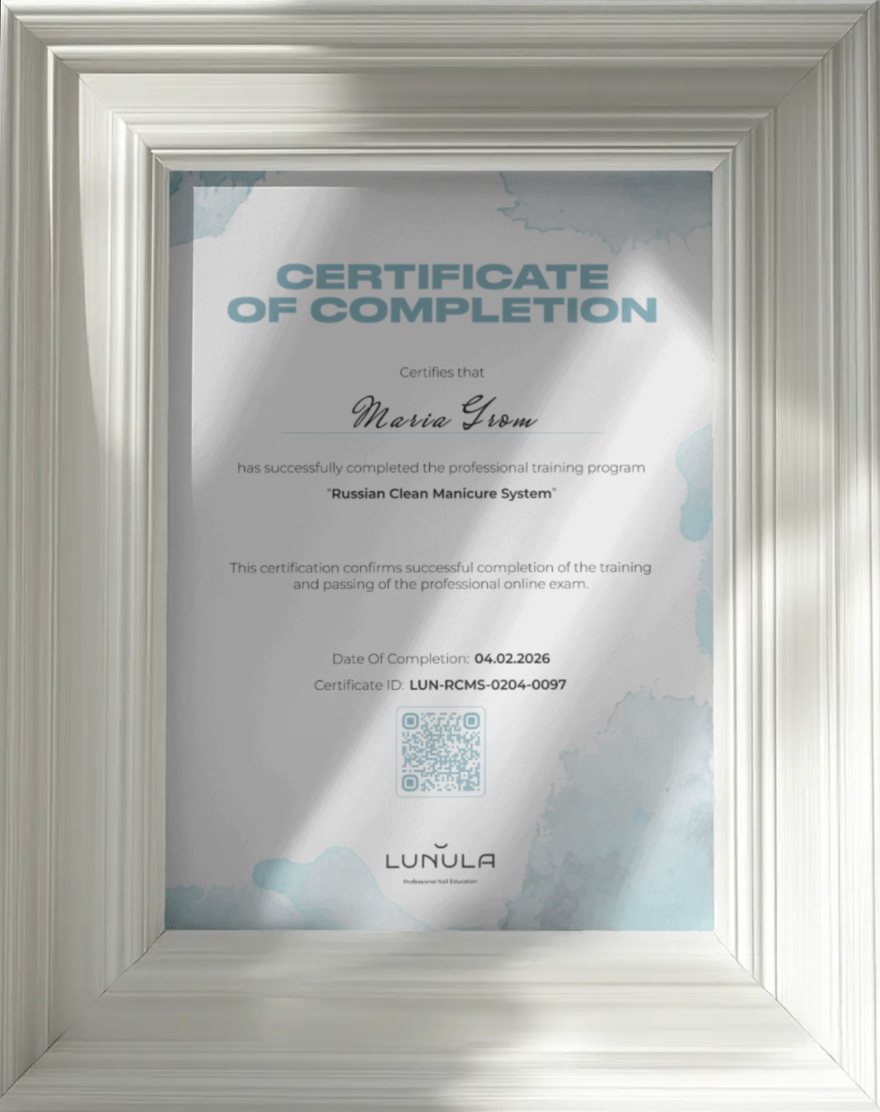
Right after a passed exam you enter your name and your Certificate of Completion is issued: your name, the date, a unique ID in the format LUN-RCMS-XXXX-XXXX and a QR code. The certificate is recorded in our certificate register at the same moment, and you can download it again at any time from your course page. It confirms that you studied the program and passed its exam; it is not a state-issued license.
How verification works
An employer or client enters the ID on our certificate verification page or scans the QR code on the certificate. The page answers from the register: valid, not found or revoked, and for a valid certificate it shows the program, the date of completion and the holder’s first name and initials, to compare with the printed name. No e-mail and no waiting are involved.
How to get certified, step by step
- Confirm your local requirements. Check whether your region requires a nail-tech or cosmetology license to work on clients, and what the rules say about e-files and live skin.
- Choose a structured program that covers the full curriculum above — not just a technique demo.
- Study the theory and the technique, ideally with material you can return to whenever you hit a real client scenario.
- Practice on models until the sequence — open the pocket, clean, cut, refine, prep, coat — becomes muscle memory.
- Pass the certification exam to confirm you’ve absorbed the material.
- Receive your certificate of completion and share its ID, so an employer can check it in seconds.
Where Lunula fits
The Advanced Clean Manicure System is the online, self-paced route to Russian manicure certification: a 60-page illustrated PDF guide across 19 modules, an online exam and a certificate of completion with an ID anyone can check — for a one-time $59 with lifetime access. It’s built to be the reference you keep coming back to, whether you’re starting from zero or organizing skills you already have, alongside the hands-on practice that no written course replaces.