Choosing a Course
How to Choose an Online Russian Manicure Course
Format, curriculum, sample pages, the instructor, practice, exam and certificate — a checklist for choosing a program that fits how you learn.
Choose the format first — a written guide, video lessons or in-person training — then check four things before you pay: a curriculum built on anatomy, safety and sanitation; a sample you can actually read; a named instructor whose work you can see; and a realistic plan for practice. An exam and a certificate add proof of training only if the certificate can be checked by its ID. No online course replaces hands-on practice or a license where one is required.
There are more Russian manicure courses than ever, at every price, from short video series to multi-day academies. They are hard to compare because they sell different things. This guide gives you a checklist that works for any course — and it is honest about where our own format fits and where it doesn’t.
PDF, video or in-person: what each format is good at
| Format | Strongest at | Watch out for |
|---|---|---|
| Written guide (PDF) | A detailed reference you keep and re-read: anatomy, diagrams, exact speeds and angles. Study offline at your own pace; usually the lowest cost. | No live demonstration; you arrange your own practice and feedback. |
| Video course | Seeing hand position, angles and movement in real time, and replaying a technique. | Quality varies, theory is often thin, and access may be time-limited. |
| In-person training | Real-time correction on a model and the fastest progress in hand skill. | Higher cost, travel and fixed dates; quality depends heavily on the educator. |
Many technicians combine them: a written or video course for the theory and the sequence, then supervised practice for the hands. Decide which part you need most right now.
Check the curriculum, not the promises
A serious program covers much more than the cuticle cut. Look for:
- Anatomy — the skin, the layers of the nail plate, and the difference between living and dead tissue.
- Contraindications — nail disorders and conditions, and when not to work.
- E-file principles — bit shapes, grits and safe speeds for each task and skin type.
- The full sequence — removal, shaping, opening the pocket, cuticle work, nail plate preparation and coating.
- Sanitation and sterilisation — the complete processing chain for reusable tools.
Be careful with marketing that promises outcomes — “zero lifting”, guaranteed income, or “certified” without saying who certifies and how. A good course tells you what it covers and what it doesn’t.
Read a real sample before you pay
A sample is the best predictor of what you are buying. Look for:
- the full table of contents, so you can see every module;
- at least one complete lesson, not just a cover and an introduction;
- diagrams and specific instructions — speeds, angles, the order of steps — rather than general advice;
- pages you can read comfortably on your phone, if that is where you will study.
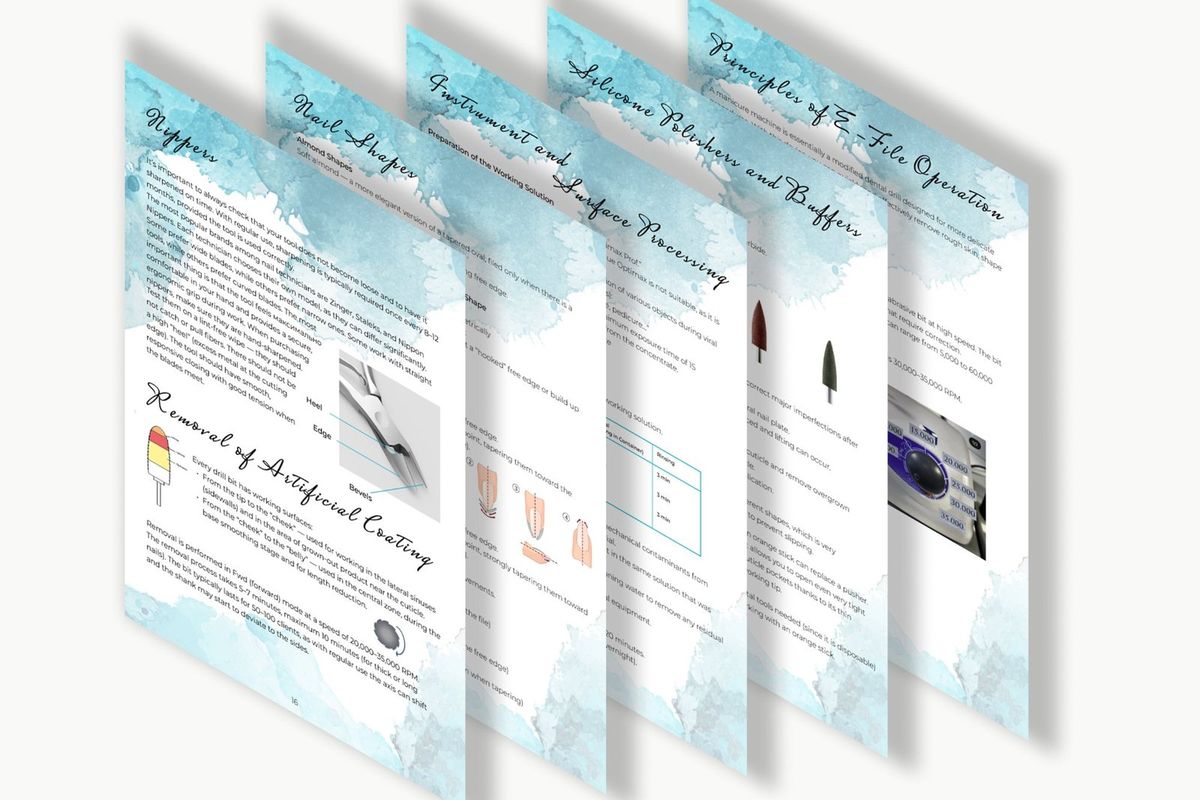
If a course shows nothing before payment, that is information too. You can see how ours looks in the sample pages of the LUNULA guide.
Look at who teaches it
Find out who is behind the course and what their role is. A named instructor with work you can see — a portfolio or an Instagram profile — tells you more than a list of titles. Treat numbers you can’t check (years of experience, awards, thousands of students) as marketing until you can verify them. You can meet the instructor behind the LUNULA course and see her work.
Plan your practice
Theory is the part a course can deliver; hand skill is the part you build. Before you buy, plan where your practice will come from: a practice hand and tips for your first e-file passes, then models, at low speeds and with sterilised tools. If you can, get feedback from an experienced technician on your first services. A course that is honest about this is a better sign than one that suggests a PDF or a video makes you salon-ready on its own.
Exam and certificate: what they really prove
An exam checks that you understood the theory; it can’t check your hands. A certificate of completion confirms that you finished a program and passed its exam. It is not a state license and doesn’t replace licensing where your region requires one — consumer guidance from the American Academy of Dermatology asks clients to check that a nail technician has the necessary experience and license.
If a course offers a certificate, ask three questions: is it issued only after a passed exam, does it carry a unique ID, and can an employer check that ID online without e-mailing anyone? More on this in how to get certified in Russian manicure online.
Who the Lunula format suits
Our Russian Manicure Course Online is a written course. It suits you if:
- you are a beginner who wants a structured foundation in anatomy, tools, technique and sanitation before practising on models;
- you already work as a nail technician and want to organise what you know and fill gaps in e-file and cuticle technique;
- you prefer a reference you can read, search and come back to at your own pace.
On its own, it is not the right fit if you need someone to watch your hands and correct you right now — combine it with in-person practice in that case.
What you get: a 60-page illustrated PDF guide in 19 modules, an online exam of 30 questions (85% to pass) and a certificate of completion with an ID that anyone can check at lunula.beauty/verify, for a one-time $59. Read the sample pages first.